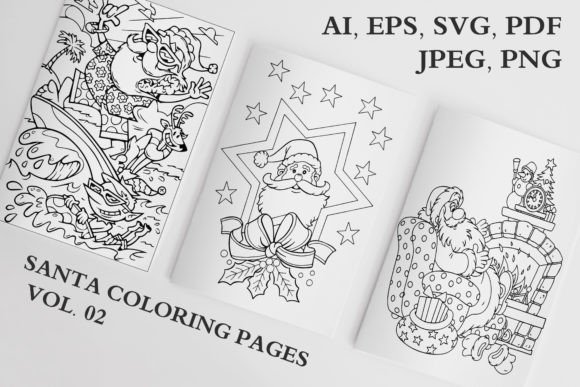
Putting Santa Coloring Pages Vol. 02 to the Embroidery Test
Let’s talk about Santa Coloring Pages Vol. 02 from a practical, hands-on perspective. As a designer who regularly turns digital files into real, stitched products for clients and my own shop, my first question is always: “How will this actually perform when I hoop the fabric?” I’m not looking at this as just a graphic; I’m evaluating it as an embroidery design asset that needs to translate beautifully into thread.
First Impression: A Playful Canvas for Stitchwork
The three high-resolution images with thick, dark lines create an immediate mood of festive fun and clarity. This isn’t a fussy, overly detailed illustration; it’s a bold, graphic statement. The personality is playful and welcoming, which tells me it’s perfect for projects aimed at families, kids, or anyone wanting a cheerful, non-traditional holiday vibe. The large 8.5 x 11 inch size is a significant note—it means these are substantial, giving you room to create a standout feature on an item.
My mind jumps to a custom embroidered sweatshirt or a holiday tote bag for a boutique. The thick lines suggest these shapes will hold up well when converted into satin stitch outlines or even as guides for applique. They feel like they belong on cozy, everyday items rather than formal decor.
The Real-Life Embroidery Scenario: A Cozy Holiday Sweatshirt
Imagine you’re preparing a limited-run holiday sweatshirt for your Etsy shop or a gift for a family member. You load one of the Santa designs, thinking it will be the centerpiece on the front. Because the files come in multiple formats—AI, EPS, SVG, PDF, JPEG, PNG—you have flexibility. For my embroidery machine, I’d work from the vector formats (AI, EPS, SVG) to ensure clean paths when converting to an embroidery file.
The “thick dark lines” are the crucial detail here. In embroidery, clear, bold outlines mean your satin stitches won’t get lost. They define the shape, making the finished product look professional and intentional from a distance and up close. On a medium-weight sweatshirt fabric, this design would pop, especially with a smart thread color choice against the fabric background. I’d envision a bright red Santa outline on a cream-colored sweatshirt—it’s giftable, recognizable, and has that handmade charm customers love.
Where This Design Shines in Your Product Line
Santa Coloring Pages Vol. 02 naturally fits a range of projects beyond apparel. Think about a playful embroidered patch for a child’s backpack, a featured motif on a kitchen towel for a festive touch, or a large center design on a pillow cover for nursery or holiday decor. Its exciting, graphic nature makes it ideal for personalized gifts and small shop merchandise where visual appeal is key.
For commercial embroidery projects, like a run of caps for a holiday event, the simplicity of the shapes is a benefit. Less intricate detail often means faster stitching and better durability on curved surfaces like caps. The design’s personality boosts the perceived value of a handmade product—it feels current and engaging, which helps with buyer engagement in your listings or at a craft fair.
Careful Application: Navigating the Stitching Details
No design is universally perfect for every scenario. With this set, the “large” size is your friend, but it also requires consideration. On a baby item or a small tea towel, you might need to scale it down significantly. When doing so, you must check the stitch density—especially if the design uses fill stitches for areas. Thick lines scaled down could become too dense for lightweight or stretchy fabrics.
Dark fabric backgrounds present another common test. The design files are provided as dark line art, so your thread color contrast is paramount. A white or metallic thread outline might be necessary. Always test on scrap fabric first. Similarly, on textured fabrics like a blanket, the bold lines will help maintain clarity, but you’ll need the right stabilizer to keep everything smooth.
The design’s corners and shapes look generous, which is good—tiny, sharp corners can be challenging for clean stitching. I’d advise inspecting the small details in your embroidery software after conversion to ensure your machine’s running stitches or satin turns will handle them well, particularly if you’re aiming for a very small hoop size.
Professional Notes for a Smooth Project
- Test First: Always stitch a sample on a scrap of your actual project fabric. Check thread color contrast and how the thick lines translate.
- Check the Background: Run a black and white mockup to see the pure shape. Compare how it looks on both light and dark fabric in your mind.
- Confirm the Scale: The large page size is great, but confirm your intended hoop size can accommodate it or a scaled version comfortably.
- Consider the End Product: For items needing frequent washing, like apparel, a cleaner, less dense design is often more durable. This seems to lean that way.
- Licensing is Key: The product is categorized under Graphics. Before selling finished items or using it in commercial embroidery, confirm the licensing terms for the digital files. This is a non-negotiable step for any professional or small business owner.
Building Trust and Professionalism with Your Work
Using a design like Santa Coloring Pages Vol. 02 effectively impacts more than just the stitch. It affects customer trust and your brand consistency. When a design stitches out cleanly and looks intentional, it reinforces the quality of your handmade presentation. A client receiving a custom embroidered tote bag with a crisp, festive Santa feels the care you put into it.
For digital product sellers, these graphic assets can be excellent for creating printable mockups or previews for your own embroidery pattern listings. The multiple file formats add versatility for your own design workflow.
In the end, my practical judgment is that Santa Coloring Pages Vol. 02 offers a strong, graphic foundation for a variety of festive embroidery projects. Its mood is playful and clear, its structure suggests good stitchability, and its size gives you room to create a statement piece. Approach it with standard professional precautions—test, check licensing, consider your fabric—and it can become a reliable part of your holiday craft business or personal gift-making repertoire.